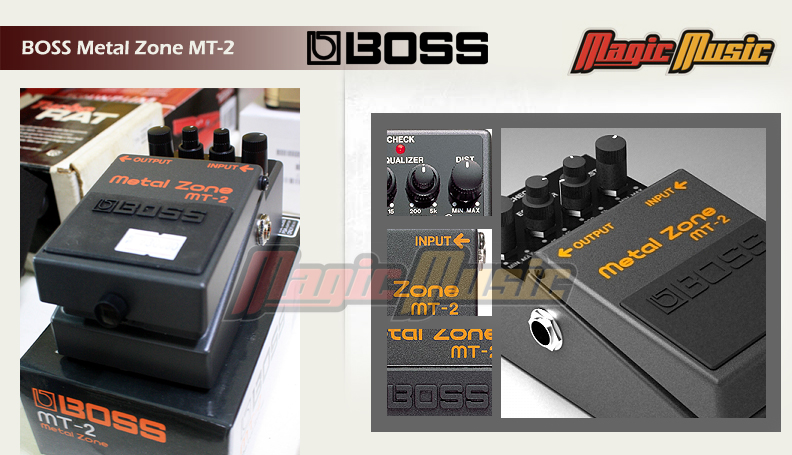
A very wide range of distortion sounds with 3-band EQ and strong sustain. The MT-2 Metal Zone is one of BOSS' most popular pedals. This stompbox provides some of the most over-the-top, insane distortion tones in the world—with huge mids and lows and an ultra-saturated sound. • Incredible-sounding distortion pedal with unique dual-gain circuitry • Provides super-long sustain and heavy mids and lows like a stack of overdriven amps • Three-band EQ with semi-parametric Mid control offers a wide range of extreme distortion textures • A must-have pedal for any hard rock or metal guitarist • BOSS five-year warranty.
Audio Library • • • Video • Audio • • • • • • • • • • • • • • • • • • Downloads • Brochures & Catalogs • • • Support • • If you have questions about operating your BOSS product, please check our for answers to the most common questions. You can also contact our department by phone or email.

Dan berikut zonagitar.net share Cara Setting Efek Gitar Metal Zone Untuk Dangdut. Software Tablature Gitar Teknik Tips And Trik Video Gitar Popular. Saya telah mencoba software ini efek2nya sangat menarik banyak banget dah. Kita seperti maen di studio aja lo pake efek ini karena tampilan efeknya itu keliatan nyata. Kaya efek2 kodok-an metal zone dsb. Tapi pas dipake di PC ane efeknya telat. Ane belom tau ni gara2 komputa ane yg lemot ap emang efek e.
In addition, we have a library of and that you can download and reference. Owner’s Manuals • • Support Documents • Forging the Future - Innovation for Creative Inspiration BOSS forges into 2008 with an awe-inspiring lineup of effects, digital studios, and accessories.
The bright, jangling tones of an acoustic guitar fit in with almost any instrument, sound beautiful on their own and are a perfect accompaniment for the human voice. But where did it come from, and how do you know which is right for you? Musician's Friend has a wide assortment from the biggest acoustic guitar makers around as well as smaller, more niche brands.
We've got everything from affordable entry-level starter packs for younger players to highly detailed one-off guitars for gigging professionals and collectors. A Brief History of the Acoustic Guitar You may be surprised to know the acoustic guitar's roots go back to Ancient Egyptian.
A lute was a hollow-bodied wood instrument with multiple strings attached to a soundboard via a thin piece of wood (the bridge).  The strings were stretched in a parallel fashion across a soundhole, and wound taut to a peg or post (tuners) atop the neck. The tension of each string was adjusted to create a pattern of frequencies familiar to those who played it. Acting chance in telugu tv serials full.
The lute had a teardrop-shaped soundboard, bowl-shaped body and a sharp bend in the neck. A lutist, much like today's guitarist, strummed or plucked the strings with their fingers or a plectrum (what we call a pick).
The sound produced was created by the air being moved around the string vibrations, the vibrations coming off the soundboard, and the air resonating back out from the body chamber through a soundhole. Fingers on the 'neck' hand change the pitch of a string by pressing it firmly against specific spots along the neck top (fingerboard). Though the lute was used through the Baroque era, the inspiration for the name 'guitar' showed up back in 13th century Western Europe with the 'gittern.' Similar in design to the lute, its body was carved out of a single piece of wood and had a smooth or straight neck joint. In the 15th century, Spain introduced the vihuela, a flat-backed, peanut-shaped design with a less pronounced neck bend and pairs of strings tuned in unison. Roughly 350 years later, Spanish-born guitar maker Antonio Torres Jurado created a larger body design and introduced fan bracing for internal reinforcement.
This made what we now call the nylon-string, Spanish or classical guitar, louder with better projection and a cleaner tone. In 1916, C.F. Martin & Company developed the square-shoulder dreadnought acoustic guitar. Named for the large battleships of the time, it was wider, deeper and yielded more volume, with a rich, well-rounded tone. Popular with the folk and bluegrass guitarists of the time, it is still the best-selling acoustic guitar shape today. Around that same time, banjo and violin manufacturers experimented with telephone transmitters to amplify the vibrations of the soundboard so guitars could be heard over the louder brass and drum sections of the era's big band setup. As technology evolved, piezoelectric transducers or condenser microphones became the norm for 'picking up' the vibrations of the acoustic soundboard.
A preamp was added to convert the weak electronic signals from the pickup, giving them a boost and sending them to an or amplifier or speaker. The first preamps were limited to simple treble (higher frequency notes) adjustment. Today's more advanced preamps offer onboard tactile control over volume, dynamic equalization, mic blending, and feedback filters and more.
Latest Posts
- Scott Pilgrim Vs The World Game Pc Emulator Download
- Spectra Plus Sc Keygen Crack Serial Generator
- Kodi Na Gta San Andreas Playstation 2 Na Russkom
- Download Game Point Blank Garena Untuk Laptop Dan Komputer Bekas
- Batang Che Shrift
- S7 200 Pc Access V10 Sp1 Download
- Portable Corel Photo Paint X5 Portable
- Chalo Na Khwahishon Ke Peeche Limca Song Free Download
- Forma 5 Gr Blank
- Malayalam Christian Drama Script Pdf
- Everycircuit Dlya Pk Torrent
- Snow Leopard Vmdk And Darwinsnow Iso File
- Vpn Autoconnect 115 Download